For a typical home with a duct run under 15 feet, no pets and average laundry volume, yes. Longer runs, shedding pets or heavy use call for every six months.
Published · Updated · by Dryer Vent Cleaning For You
Annual is the standard answer, but it is the wrong one for plenty of homes. Here is how to work out the right interval for yours.
The short answer is once a year. It is the interval most dryer manufacturers reference, it is what the fire services recommend, and for a compact home with a short duct run and two adults it is genuinely enough.
The longer answer is that once a year describes an average house, and plenty of houses are not average. Four things push the interval shorter, and they are worth checking before you assume annual is right for you.
1. How long is the duct run?
This is the biggest factor and the one homeowners think about least. Dryer manufacturers typically allow around 25 feet of duct, then require you to subtract about 5 feet for every 90-degree elbow and 2.5 feet for every 45. A laundry room on the second floor with three elbows can consume that entire allowance before it reaches daylight.
Long runs do not just hold more lint — they hold it more stubbornly, because air velocity drops along the length and the lint settles rather than blowing clear. If your run is over about 15 feet, or has three or more elbows, plan on every six to nine months.
Rule of thumb: under 15 feet and two elbows, annual is fine. Over that, halve the interval.
2. Do you have pets that shed?
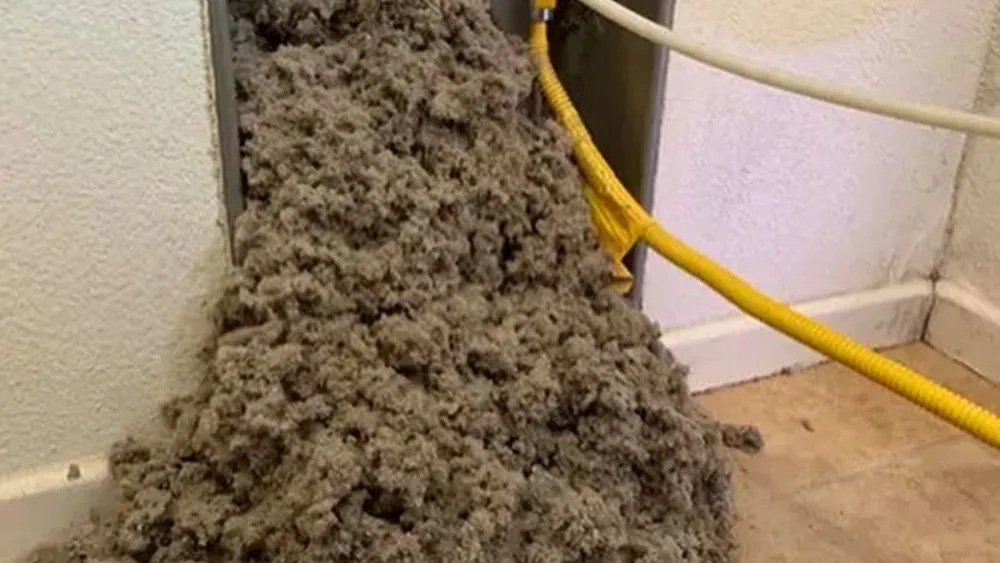
Pet hair binds with lint into a dense mat that packs far more tightly than lint alone. A household with two shedding dogs will load a duct at roughly twice the rate of the same household without them. Six-monthly is realistic.
3. How many loads a week?
A single person doing two loads a week and a family of five doing fifteen are not on the same schedule. Loads per week is a better predictor than years elapsed. If you are running the dryer most days, do not wait a full year.
4. Where does the vent terminate?
Roof terminations collect more and get inspected less, because nobody can see them from the ground. Ground-level side-wall hoods are easier to keep an eye on but are more exposed to nesting birds in spring — a real issue along the Front Range from April onwards.
The signs that override the schedule
Whatever interval you have settled on, these symptoms mean the vent needs attention now rather than at the next scheduled visit:
- Clothes are still damp after a full, normal cycle
- Drying regularly takes two or three cycles
- The dryer casing or the laundry room itself gets noticeably hot
- There is a burning smell, or a musty one, while the dryer runs
- Lint is visible around the outside vent hood
- The flap on the exterior hood does not open when the dryer is running
That last one is the most reliable single test you can do without any tools. Start the dryer, walk outside, and look at the hood. If the flap is not being pushed open by the airflow, something between the dryer and that hood is blocked.
Why the interval matters
Two reasons, and they are not equally weighted. The first is safety: the U.S. Fire Administration attributes roughly 2,900 residential building dryer fires a year, and failure to clean the vent is the leading contributing cause. The second is cost — a restricted vent makes every single load run longer, which shows up on the utility bill and shortens the life of an appliance that is not cheap to replace.
Not sure which category your home falls into? Phone estimates are free, and we will tell you honestly whether you need us this year or next.
Call (720) 545-5983Request a quoteWhat a proper cleaning involves
Worth knowing so you can tell a real service from a quick vacuum at the hood. A full dryer vent cleaning means rotary brushing the entire run with vacuum capture at the source, pulling the dryer out to clean behind it, clearing and testing the exterior hood and damper, and measuring airflow before and after so the result is verifiable rather than asserted.
If the inspection turns up crushed or disconnected ducting, that is a repair rather than a cleaning, and it should be quoted separately and clearly before anyone starts work.
Need this done rather than explained?
We are a family owned company in Highlands Ranch serving Littleton, Lone Tree, Centennial, Parker and the rest of the south Denver metro. Estimates over the phone are free.
(720) 545-5983 Request a quoteMore reading
Good Questions
Related Questions
Is once a year enough for a dryer vent?
Can I clean a dryer vent myself?
You can vacuum the first few feet and the lint trap housing, which helps. The compacted lint in the middle of the run and at elbows needs a rotary brush and vacuum capture to remove properly.
How often should a dryer vent be cleaned?
For most households, once a year. If you have a large family, pets that shed, or a duct run longer than about 15 feet, plan on every six months. Homes where the dryer vents through the roof also tend to need more frequent service.
What are the signs that my dryer vent is clogged?
Clothes still damp at the end of a normal cycle, drying that needs two or three cycles, a dryer that is hot to the touch, a burning or musty smell, a laundry room that gets hot and humid, lint gathering around the outside vent hood, or a vent flap that no longer opens when the dryer runs.